


Geography

In Geography our aim is to cultivate not only an understanding of the physical and human processes which shape our world today and in the future, but to foster a geographical curiosity to understand the world. Our curriculum is grounded in this core principle, that good knowledge is the grounding to enabling students to engage and form their own opinions. It is designed to let students engage with the wider world and to produce well-informed, confident and responsible global citizens with the skills and knowledge to investigate the world.
Key Stage 3
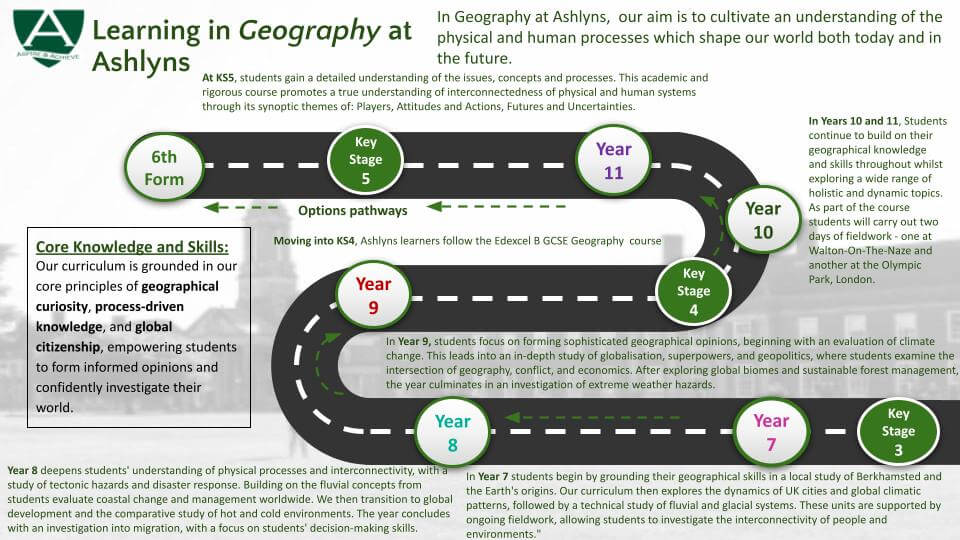
Our KS3 curriculum is sequenced to enable students to build on their geographical skills, prior knowledge and understanding. It is knowledge-rich, allowing students to build awareness of locations, places and environments at a range of scales. We engage students with critical, up to date issues and concepts using a broad spectrum of resources from OS maps, geographical journals to GIS. We provide students with the tools to develop their skills and confidence to enable them to become enquiring and independent learners. Geographical skills and key terminology are embedded throughout KS3. Fieldwork opportunities in the local area allow students to develop a clear understanding of a route to enquiry and grow their sense of place.
Year 7
Students begin by building on their existing geographical skills, providing a solid base from which to develop their understanding. An introduction to the geographic origins of the Earth and then a local area study of Berkhamsted provides a sound base on which our Year 7’s can build on. Our first human unit investigates how cities change, especially across the UK. Students then explore our weather and climate, including extreme weather around the world. Using this grounding students then start to investigate rivers, how they change, and how we manage them. To end the year students investigate glaciers, and the inter connectivity of people and processes surrounding them. Throughout the year students take part in fieldwork activities around the school.
Year 8
We continue to build and expand on their geographical skills and knowledge gained in year 7 by furthering students’ understanding of physical processes, interconnectivity and sustainability. Starting the year with a unit on tectonics, students investigate not only the processes and distribution of hazards, but also how they would handle and respond to disasters. Following on from their work with rivers in year 7, our year 8’s investigate our changing coastlines around the world, before finishing by investigating how they would protect different coastlines. Students then look into the varying levels of development around the world, and how different areas are tackling these issues. Once again students also investigate how they would respond and help development. Year 8 then go a step further from year 7 and glaciers, investigating the differences between hot and cold deserts around the world. They end the year by investigating migration, why people migrate, how this has changed over time and how different communities and countries react to migration. Throughout the year students focus on their decision making skills and their own responses to different situations.
Year 9
Throughout year 9 students focus on developing their geographic opinions. Starting with climate change students investigate not only the causes, impacts and solutions, but how they would manage the impacts and responses to climate change. Students then begin an in-depth study into globalisation, superpowers and geopolitics. Focusing on different conflicts throughout history and across the world students look into the links between geography and history, economics and governments. We then begin our focus into different biomes and their resources, leading into our unit on how different forests are managed around the world sustainably. Our final topic is an investigation into extreme weather, and the part that climate change plays in this. Students end the year looking at how they would respond to a hazard, and create judgments on whether they agree with different management strategies.
Key Stage 4
Geography GCSE is a popular choice at Ashlyns and is an exciting and engaging course taught by geography specialists. We deliver the Edexcel B specification. Our curriculum has been designed to promote the skills, independence and geographical understanding needed to succeed at GCSE and beyond
The GCSE course is based on a balanced framework of physical and human geography. It allows students to investigate the link between the two themes, and approach and examine the battles between the man-made and natural worlds. Students continue to build on their geographical knowledge and skills throughout whilst exploring a wide range of holistic and dynamic topics. As part of the course students will carry out two days of fieldwork one in Walton-On-The-Naze at the beach and another at the Queen Elizabeth Olympic Park in London. Students also have the exciting opportunity of an Iceland trip in October in Year 11.
Over the two years of KS4, students continue to develop their understanding of the world, studying global geographical issues including hazards, development dynamics and the challenges of the urbanising world, with a focus on India and Mumbai. UK geographical issues include UK physical geography (rivers and coasts) as well as human geography in the UK with a focus on London. Finally students study issues with people and environments focusing on people and the biosphere, forests under threat and consuming energy resources.
Key Stage 5
At KS5, students gain a detailed understanding of the issues, concepts and processes. This academic and rigorous course promotes a true understanding of interconnectedness of physical and human systems through its synoptic themes of: Players, Attitudes and Actions, and Futures and Uncertainties.
Students will explore the following topics at A Level;
Dynamic Landscapes
Tectonic processes/hazards and coastal landscapes,
Physical Systems and Sustainability
The water cycle/water insecurity and the carbon cycle/energy security,
Dynamic Places
Globalisation and regenerating places
Global Development and Connections
Superpowers and health, human rights and intervention.
Students also complete an independent investigation (worth 20%) with a title of their choice. Students must complete 4 days of compulsory fieldwork prior to designing their NEA, which we currently carry out as a residential trip to Swanage in the summer term of Year 12.
Learning beyond the classroom
Offering a wide range of fieldwork opportunities both in the local area and nationally in contrasting areas to our own setting gives students a wealth of opportunities to develop skills and build an awareness of locations, places and environments at a range of scales. Students are also invited to participate in our annual Iceland trip in Year 11.
At KS3 students are encouraged to participate in our house events with flags of the world and capital cities. We even have some students entering RGS Young Geographer of the Year competition, aiming for a green blue peter badge and the British Antarctic Territory design a flag competition.